Contrast a massive, expensive studio commercial with a shaky, unedited smartphone video shot from a car seat, and you will find a stark reality: the car video consistently drives triple the sales volume.
To capture consumer attention in 2026, brands must stop acting like corporate broadcasters and start acting like native users, embracing the unpolished, lo-fi aesthetic to bypass profound consumer ad-blindness and build genuine trust.
High-fidelity productions trigger immediate psychological defence mechanisms, whereas raw, human-led content acts as a peer recommendation, significantly lowering customer acquisition costs. You can read Wyzowl’s comprehensive breakdown of video marketing adoption trends here.
Consumers have developed an absolute, reflexive blindness to highly produced, traditional advertisements, scrolling past them before the core message even registers.
This rejection is not accidental; it is a learned survival mechanism in an digital ecosystem saturated with hyper-curated, artificially generated content. When your audience sees a ring light reflection, a pristine studio backdrop, or a perfectly colour-graded sequence, their brain instantly categorises the content as an outbound sales pitch rather than valuable information.
The most valuable currency on social media today is not production value; it is human connection, and acquiring that currency requires a fundamental restructuring of your marketing budgets.
Redirecting funds away from massive flagship productions toward continuous, iterative, smartphone-shot content allows you to test multiple messaging angles simultaneously while maintaining an authentic brand voice.
A 2026 study by HubSpot found that short-form video delivers the highest return on investment across all digital channels — you can explore the methodology here.
Deconstructing the Lo-Fi Aesthetic
Understanding the lo-fi aesthetic begins with a crucial distinction: it is not about being lazy, offensive, or technically incompetent. It is a highly strategic deployment of visual language designed to look completely native to the social platform on which it is published, ensuring the content matches the surrounding organic posts.
If your advertisement looks like an advertisement, you have already lost the battle for attention in the feed. The Guardian recently examined why [unpolished aesthetics dominate modern feeds] — their findings are worth reading in full.
Strategic lo-fi marketing relies heavily on natural, unoptimised lighting rather than complex, multi-point studio setups. Filming whilst sitting next to a window, walking outside, or relying on ambient room illumination replicates the exact conditions in which everyday users create their own content, immediately fostering visual kinship.
Minimal editing is another hallmark of this approach, deliberately leaving in minor imperfections that traditional agencies would spend hours removing.
A slight stutter, an audible breath, or a momentary pause before speaking signals to the viewer that they are listening to a genuine human being rather than an actor reading a teleprompter.
Semrush outlines the current guidance on retaining human elements in content marketing in detail.
Platform literacy dictates that marketers must abandon imported, slick graphics in favour of the native text editors provided by the social applications themselves.
When you use TikTok’s default captions or Instagram’s native font stickers, you signal to the algorithm and the audience that you are an active participant in the community, not a foreign corporate entity broadcasting from afar.
The pacing of these videos often mimics the highly successful “Get Ready With Me” (GRWM) format, where the narrative unfolds conversationally whilst the subject performs a secondary, mundane task. This multitasking approach lowers the viewer’s defensive barriers, making the core marketing message feel like incidental advice shared between friends rather than a direct sales pitch.
A 2026 study by the Journal of Consumer Marketing found that conversational pacing directly enhances brand recall — you can explore the methodology here.
There is, however, a profound difference between strategic authenticity and genuine sloppiness, and crossing that line will severely damage your brand equity. Visual imperfections are welcomed, but fundamental failures in delivery, such as confusing product value propositions or offensive messaging, will still result in immediate user abandonment.
Furthermore, the lo-fi approach requires a high volume of output to remain effective, meaning your team must shift from a campaign-based mindset to an always-on, iterative publishing cadence.
Rather than spending three months perfecting a single video, you must shoot, edit, and publish multiple times a week, allowing real-time data to dictate your content direction.
To execute this volume without exhausting your creative resources, you must empower your internal subject matter experts to film themselves autonomously.
Equipping your product managers, sales representatives, and customer success teams with basic smartphone tripods transforms your entire workforce into a scalable, highly authentic media engine. Research from Impression Digital confirms that employee-generated posts are reshared exponentially more than branded posts — the full report on user-generated content is available here.
Ultimately, the lo-fi aesthetic strips away the corporate veneer, forcing your marketing to rely entirely on the strength of your actual product and your ability to articulate its value clearly.
When you can no longer hide behind cinematic lighting and expensive post-production, your core value proposition must be undeniably compelling to keep the viewer watching.
A 2026 study by Wistia found that educational content retains viewers longer regardless of production value — you can explore the methodology here.
The Psychology Behind the Shift: Why Polished Content Fails
The psychological mechanisms driving the success of lo-fi content are rooted in the modern consumer’s exhaustive exposure to digital persuasion.
Over the past decade, internet users have developed a rigorous, subconscious defence mechanism that immediately identifies and filters out polished content, treating it as hostile cognitive load. When a video opens with a sweeping drone shot or a highly stylised title card, an internal alarm sounds, warning the user that they are about to be sold to.
This defence mechanism is completely bypassed by the “FaceTime effect,” a phenomenon where lo-fi content mimics the exact visual and auditory cues we experience when communicating with our closest friends and family.
Filming up close, at eye level, and with a slightly shaky frame tricks the brain into applying the same social expectations and emotional openness reserved for personal relationships to a brand interaction.
Parasocial interaction theory explains why users develop deep, one-sided emotional attachments to content creators who present themselves without a corporate filter.
By actively performing vulnerability—such as recording from a messy home office or admitting a minor mistake on camera—marketers cultivate an incredibly lucrative trust architecture that scales globally. Research from SAGE Publications confirms that social media has entirely transformed into parasocial media — the full report is available here.
This craving for authenticity is a direct cultural backlash against years of heavily filtered, algorithmically curated feeds that presented an unattainable, sterilised version of reality. Consumers are exhausted by the pursuit of aesthetic perfection, leading them to view high-fidelity brand messaging as inherently deceitful or out of touch with their actual daily struggles.
The Wall Street Journal recently examined why [Gen Z actively rejects curated brand personas] — their findings are worth reading in full.
In 2026, perfection feels untrustworthy because it implies that a message has been carefully sanitised, focus-grouped, and approved by a legal department before it reaches the public.
Consumers want to see the rough edges of a company, as transparency regarding process and failure signals that the brand respects the audience’s intelligence enough to show the reality of their operations.
A 2026 study by Edelman found that brand transparency is now the leading indicator of purchase intent — you can [explore the methodology] here.
The psychological shift also relates to decision fatigue; buyers are overwhelmed by choice and crave plain-language explanations that reduce their cognitive burden.
Human-led video provides unparalleled clarity, allowing a real person to look directly into the camera and state precisely who a product is for and what problem it solves, devoid of corporate jargon. Blueshift outlines the(https://blueshift.com/blog/2026-b2c-marketing-strategy/) in detail.
Furthermore, lo-fi content democratises the perceived power dynamic between the corporation and the consumer, levelling the playing field. When a brand acts as a peer operating within the same digital constraints as the user, it fosters a sense of community and shared cultural understanding rather than hierarchical dominance.
This levelling effect is crucial for fostering off-platform influence, particularly within “dark social” channels like direct messages, private Discord servers, and WhatsApp groups.
Users are infinitely more likely to share a quirky, unpolished video with their peers in a private chat than they are a rigid corporate advertisement, amplifying your reach organically.
Research from Nielsen confirms that dark social sharing accounts for the majority of modern brand discovery — the [full report] is available here.
Ultimately, the psychology of lo-fi marketing proves that overstatement carries a much higher commercial cost than understatement in the modern economy.
Brands that speak quietly, authentically, and consistently build long-term credibility, whereas those that shout through expensive, high-gloss megaphones are increasingly muted by the audience.
A 2026 study by ClickZ found that consumers now evaluate credibility over time rather than through immediate, dramatic claims — you can explore the methodology here.
B2C Case Studies: The Beauty and FMCG Revolutions
The beauty and cosmetics sector has historically relied on the promise of dramatic transformation, utilising extensive retouching and flawless studio lighting to sell an idealised outcome.
However, by 2026, the most successful brands have completely abandoned this model, discovering that consumers demand to see how products perform on real skin with natural imperfections.
Iconic London provides a definitive case study in this transition, having systematically replaced their highly polished campaign assets with raw user-generated content and customer selfie-reviews.
By showcasing their makeup in everyday lighting environments, they provided the crucial context and demonstration required for consumers to evaluate the product authentically. You can read Impression Digital’s full breakdown of Iconic London’s strategy here.
This strategic pivot toward lo-fi authenticity generated staggering commercial results, capturing consumer awareness and drastically improving the digital user experience.
The unedited tutorials and tip videos resonated so deeply with their target demographic that the brand experienced a one hundred and twenty-six percent lift in overall conversion rates.
Jones Road Beauty executed a similarly rigorous approach on TikTok, constantly A/B testing highly produced product demonstrations against raw, unfiltered user reaction videos.
The data definitively proved that the winning creatives were those showing real customers experiencing the product for the first time, complete with unscripted surprise and genuine emotional reactions. A 2026 study by Signalytics found that these lo-fi reaction videos led to a two hundred percent increase in direct sales — you can explore the methodology here.
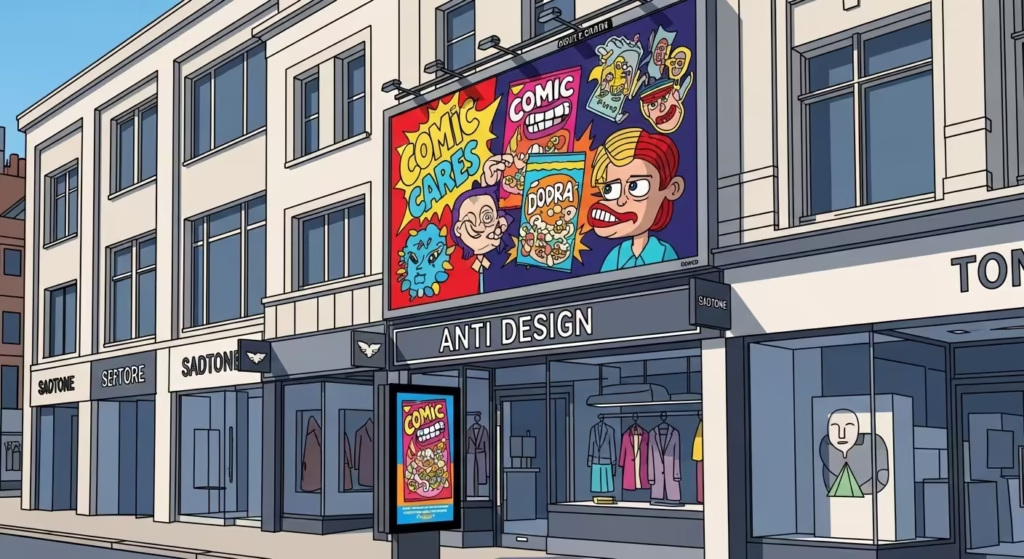
Beyond the beauty sector, fast-moving consumer goods (FMCG) brands are leveraging an extreme variant of the lo-fi aesthetic known as “anti-design” to disrupt saturated retail markets.
Surreal Cereal built a one and a half million pound brand in its first year by deliberately breaking every traditional rule of graphic design and corporate messaging.
Rather than investing in sleek packaging commercials, Surreal Cereal launched chaotic, meme-inspired campaigns featuring universally mocked fonts, clashing colours, and fake celebrity endorsements.
This deliberate aesthetic sabotage acted as a massive pattern interrupt, signalling to the audience that the brand refused to take itself too seriously while perfectly mirroring internet subcultures. You can read OptiMonk’s at https://www.optimonk.com/surreal-cereal-marketing-strategy).
On professional platforms like LinkedIn, the brand utilised text-heavy, unpolished document carousels that humorously dissected the absurdities of modern office culture. They disguised their product marketing within these relatable, lo-fi complaints about communal fridges and small talk, generating over one hundred and forty-four thousand engaged followers organically.
Research from StoryChief confirms that humour-led B2B crossover campaigns drastically outperform standard corporate updates — the full report is available here.
Retail giant Boots UK approached the lo-fi revolution by decentralising their content creation, transforming their retail staff into influential brand ambassadors on social media. By encouraging employees to film behind-the-scenes snippets and daily store routines, they humanised the massive corporate entity and provided relatable, hyper-localised content.
These B2C examples prove that abandoning the pursuit of absolute visual perfection allows brands to move faster, test more messaging variants, and connect with their audience on a fundamentally human level.
The financial efficiency of producing lo-fi content combined with its disproportionately high conversion rate creates an arbitrage opportunity that modern marketers cannot ignore. Forbes recently examined why [agile production models are replacing traditional agencies] — their findings are worth reading in full.
How B2B SaaS Brands Can Leverage Lo-Fi Screen Recordings
The business-to-business software as a service (B2B SaaS) landscape has undergone a radical transformation, with buyers now demanding absolute product transparency before they will even consider interacting with a sales representative.
The traditional playbook of gating software behind highly polished, animated explainer videos that vaguely discuss features without showing the interface is completely obsolete in 2026.
According to extensive market research, eighty-eight percent of modern software buyers outright refuse to book a sales discovery call without having seen the actual product functioning in a real-world scenario.
They do not want metaphors or beautifully rendered motion graphics; they want raw, asynchronous screen recordings that prove the software operates as advertised without lagging or excessive complexity.
The most effective and highest-converting format in this new environment is the “Founder Mode” welcome video, typically captured using a simple webcam and screen recording software.
In these assets, a product lead or founder looks directly into their laptop camera and plainly articulates the value proposition in under sixty seconds, providing a stark, authentic contrast to faceless enterprise marketing.
| B2B SaaS Funnel Stage | Average Conversion Rate (2026) | Top Performer Rate | Recommended Lo-Fi Intervention |
| Visitor to Lead | 1.5% – 2.5% | 8% – 15% | Founder-led webcam welcome videos |
| MQL to SQL | 32% – 40% | 50%+ | Asynchronous, unedited screen demos |
| SQL to Close | 20% – 25% | 30%+ | Raw customer webcam testimonials |
Companies like Todoist and Buy Me a Coffee have mastered this approach, replacing generic hero sections with simple, authentic founder videos that feel identical to a one-on-one Zoom consultation. This signals to the prospect that there are real, accessible human beings behind the software, cutting through the inherent scepticism associated with complex B2B purchasing decisions.
A 2026 study by SaaSHero found that these humanised touchpoints accelerate the MQL-to-SQL pipeline significantly — you can explore the methodology here.
To ensure these high-converting assets reach your target demographic, they must be embedded within a technically sound infrastructure managed through(https://invernessdesignstudio.com/seo-services).
Customer testimonials in the B2B sector have also migrated away from heavily scripted, professionally lit studio productions towards raw, asynchronous video submissions.
Collecting unedited webcam clips from actual users explaining specific operational problems the software solved provides verifiable social proof that resonates far more than a glossy logo carousel.
You can read Prospeo’s(https://prospeo.io/s/b2b-conversion-rates) here.
Furthermore, the “TikTok-ification” of B2B marketing has led to the rise of micro-looping, three-to-five-second vertical videos replacing static feature icons on SaaS landing pages.
Instead of telling the user that the software has a drag-and-drop interface, these silent, lo-fi screen recordings simply show the action repeatedly, providing undeniable visual proof that eliminates buyer doubt instantly.
Research from Averi confirms that product-led visual content drastically lowers landing page bounce rates — the full report is available here.
When creating these SaaS explainer videos, the absolute rule is to focus on the business outcome rather than an exhaustive, monotonous list of technical features. The recording must act as a bridge between the user’s specific frustration and your exact solution, walking through the core actions a user takes with real data.
Komet Media outlines the current guidance on outcome-focused product videos in detail.
Ultimately, a high-conversion lo-fi SaaS video teaches first and reveals product utility naturally, making the learning process feel less like reading a manual and more like receiving advice from a colleague.
By leaning into authentic customer speech, unedited dashboard walkthroughs, and raw screen captures, B2B companies can dramatically shorten their sales cycles and lower customer acquisition costs.
A 2026 study by Black Rabbit found that outcome-driven product videos retain enterprise buyers twice as long as traditional explainers — you can explore the methodology here.
Evaluating Screen Recording Tools for High-Conversion Demos
Selecting the appropriate software to capture these unpolished software demonstrations is critical, as the technology must empower founders and marketing teams to publish quickly without creating a massive editing backlog.
For SaaS founders, the best screen recorder is not necessarily the one with the most complex feature set, but rather the one that gets a clear, authoritative demo published with minimal friction. You can read Cubix Editor’s full breakdown of modern screen recording tools here.
For fast, asynchronous communication, internal team updates, and rapid customer support responses, Loom remains the undisputed industry standard due to its speed and simplicity.
It allows users to instantly record their screen and webcam, automatically generating instant share links, AI-driven summaries, and tracking notifications when a prospect views the asset.
However, when producing conversion-oriented public demonstrations where visual presentation directly impacts trust, tools that offer slightly more cinematic control without requiring deep editing skills are preferred.
Screen Studio has become the go-to platform for Mac users, automatically applying smooth cursor tracking, live auto-zooms, and premium background styling while the user simply navigates their software. Wired outlines the [current guidance on premium asynchronous capture tools] in detail.
Tella offers another robust alternative, positioning itself as an all-in-one cloud-based recorder and editor that provides robust layouts, overlays, and AI-assisted edits.
While it requires a slightly higher investment and a steeper learning curve than simple capture tools, it allows creators to stitch together multiple lo-fi clips, screen recordings, and camera angles into a cohesive, highly engaging narrative format.
The integration of artificial intelligence is fundamentally altering this software category, particularly in the realm of customer onboarding and automated documentation.
Platforms like Guidde utilise AI to monitor a user’s screen interactions, automatically generating step-by-step visual walkthroughs and professional voiceovers eleven times faster than manual video production. You can read Wyzowl’s full breakdown of AI-powered video onboarding here.
This automation is critical because software companies that implement video-based onboarding see a thirty-four percent faster time-to-value for new customers and significantly higher retention rates.
By removing the technical overhead of video editing, these tools allow product teams to continuously update their lo-fi training materials alongside rapid software deployment cycles without delay.
Ultimately, the tool you choose must align with your team’s technical proficiency and your overarching marketing goals, prioritising speed to publication over cinematic perfection.
The objective is to maintain the raw, authentic feel of a personal walkthrough while ensuring the interface remains legible and the narrative remains focused on solving the buyer’s specific problem.
The Critical Distinction: Audio Fidelity Versus Visual Polish
While consumers actively reward unpolished, raw visual aesthetics in 2026, they maintain a remarkably low tolerance for poor audio quality, making sound the most critical technical element of lo-fi marketing. A shaky smartphone camera or a slightly poorly lit room adds authenticity to a narrative, but wind noise, heavy room echo, or peaking microphones will cause immediate, physical listener fatigue.
You can read Finchley Studios’ full breakdown of acoustic integrity in digital media here.
Listeners have been conditioned by years of professionally produced podcasts and media to expect crisp, intelligible dialogue, and failing to meet this baseline subconsciously signals incompetence to the viewer.
A user may forgive an uninspired visual framing or a chaotic background for several minutes, but they will rarely tolerate distorted sound that requires active cognitive strain to understand.
This strict dichotomy between visual and auditory expectations forces marketers to invest strategically in sound capture technology even when filming deliberately lo-fi visual assets.
Utilising a discrete wireless lavalier microphone or a high-quality shotgun microphone paired with a standard smartphone ensures the dialogue remains authoritative and clear, perfectly balancing professional sound with casual visuals.
The rapid advancement of artificial intelligence video generation models in 2026 has further complicated this dynamic, as different tools prioritise distinct outputs for digital content creators.
Veo 3.1, for example, provides exceptional visual polish and highly realistic native audio generation, making it the premier choice for creating managed, high-fidelity shorts that require minimal post-production intervention.
You can read Atlas Cloud’s full breakdown of AI video generation capabilities here.
Conversely, open-source models like Wan 2.7 offer incredible visual control and the unique ability to fine-tune the output to match a brand’s specific, unpolished aesthetic guidelines.
However, these models often require external audio syncing and dedicated workflow tools like Miraflow AI to ensure the final product meets the stringent auditory expectations of the modern consumer.
A 2026 study by Miraflow AI found that intelligent AI workflows combining visual control with external audio mastering yield the highest engagement — you can explore the methodology here.
The most successful creators and brands in 2026 do not rely on a single model or a single approach; they build intelligent production pipelines that guarantee sonic excellence regardless of visual fidelity.
This means treating audio engineering as a non-negotiable phase of the lo-fi production process, utilising AI enhancement tools to remove background noise and level dialogue tracks before publication.
Ultimately, the rule for modern lo-fi marketing is simple: your visuals can be as raw and chaotic as necessary to capture attention, but your audio must be flawlessly engineered to retain it.
By mastering this balance, brands can project an image of effortless authenticity while maintaining the authoritative communication standards required to close high-value commercial transactions.

Platform-Specific Strategies for Native Content in 2026
To truly master lo-fi marketing and maximise your return on investment, your content must be meticulously tailored to the specific behavioural norms, algorithms, and native formats of the platform on which it is published.
What functions brilliantly as a raw, vertical hook on TikTok will likely fail completely if uploaded unedited to a professional network like LinkedIn, as user intent varies wildly between applications.
On LinkedIn, which has definitively surpassed YouTube as the primary video distribution channel for B2B companies, audiences crave simple, helpful frameworks delivered with a behind-the-scenes feel.
While overall video views on the platform have seen a slight downward trend, engagement rates have skyrocketed for raw, horizontal clips between three and six minutes that outline a specific thought process or business strategy. Research from Socialinsider confirms that unpolished B2B video content drives an average engagement rate of six percent — the full report is available here.
TikTok, conversely, continues to dictate the pace of the B2C lo-fi movement, operating in an environment that explicitly rewards spontaneity, trend-responsiveness, and native platform integration.
Brands that attempt to repurpose polished, horizontal television commercials for vertical feeds are universally ignored, whereas those that embrace native text editors, trending audio clips, and rapid pacing see massive organic distribution. Adweek outlines the in detail.
Interestingly, the sweet spot for short-form video duration across platforms like TikTok, Instagram Reels, and YouTube Shorts is steadily increasing, moving away from frantic fifteen-second clips towards longer, forty-five to sixty-second narratives.
This added duration provides marketers with the necessary breathing room to expand beyond a simple visual hook into deeper storytelling, educational walkthroughs, and complex product demonstrations. You can read Taboola’s full breakdown of short-form video evolution here.
YouTube Shorts specifically has become a massive discovery engine, capturing significant attention with users spending over ten minutes per session navigating the platform’s short-form feed.
These lo-fi clips are no longer just promotional snippets; they are an integral step in the viewing journey, helping audiences discover brands and inspiring them to seek out longer, deep-dive content on the main channel.
A 2026 study by YouGov found that seventy-seven percent of viewers who watch a social media clip go on to watch the full programme — you can explore the methodology here.
Furthermore, long-form, unpolished content remains incredibly vital, particularly in the form of interactive webinars and live streams that allow subject matter experts to speak extemporaneously.
The slightly unpredictable nature of a live broadcast, complete with audience Q&A sessions and occasional screen-sharing hiccups, perfectly encapsulates the value-first, authentic ethos of the broader lo-fi movement.
Research from ON24 confirms that on-demand webinar viewing now accounts for fifty percent of all attendee engagement — the full report is available here.
Ultimately, mastering these platform-specific nuances requires a dedicated social media manager who understands the subtle cultural dialects of each application and can adjust the brand’s lo-fi assets accordingly.
By treating each platform as a unique ecosystem rather than a monolithic distribution channel, brands can ensure their raw content always feels entirely native, respectful, and highly engaging.
Measuring the ROI of User-Generated Content
Securing ongoing executive buy-in and budget for lo-fi marketing initiatives requires translating the somewhat abstract concept of “authenticity” into measurable pipeline generation and definitive return on investment.
Traditional vanity metrics like gross impressions and total reach are increasingly deprioritised by modern growth teams in favour of deep engagement indicators, such as average watch time, save rates, and direct conversion assists.
Social engagement metrics—specifically shares, comments, and direct message forwards—are currently the fastest-rising video success indicators across all industries, as they represent active cognitive investment from the user. When an individual takes the time to share an unpolished brand video with a colleague, they are effectively endorsing the content, providing a level of third-party validation that money cannot buy.
| Metric Category | Traditional KPI Equivalent | Primary Value Indicated by Lo-Fi Content |
| Retention Rate | Impressions | Proves the unpolished hook bypassed ad-blindness |
| Share of Voice | Brand Awareness | Measures organic community distribution and relevance |
| Assist Rate | Click-Through Rate | Tracks multi-touch pipeline influence and trust building |
When properly executed, the inherent cost-efficiency of lo-fi content creation drastically improves the overall profitability and operational agility of the entire marketing department.
By relying heavily on smartphone production, employee-generated content, and AI-assisted editing tools, brands can produce an exponentially higher volume of assets at a fraction of the cost of a single agency-led studio campaign. A 2026 study by Digital Applied found that AI has cut median video production costs by forty percent — you can explore the methodology here.
Furthermore, integrating these unpolished, highly authentic video assets directly onto high-intent landing pages provides a massive, measurable lift in final conversion rates.
For complex products or high-ticket services, a simple, human-led explainer video immediately reduces the cognitive load required to understand the offering, pushing hesitant prospects over the final conversion line.
The data clearly indicates that while heavily polished content may win industry design awards, it is the raw, human-led content that ultimately drives sustainable, measurable revenue growth.
By shifting the departmental focus from pursuing production value to prioritising information gain and relational trust, marketing teams can definitively prove the financial superiority of acting like a native user.

Balancing Brand Safety With Raw Authenticity
One of the most significant and persistent challenges in adopting a lo-fi marketing strategy is overcoming internal pushback from stakeholders who mistakenly equate unpolished aesthetics with a lack of corporate professionalism.
Chief Marketing Officers, legal departments, and public relations teams are naturally risk-averse, often fearing that raw, unscripted content will damage the carefully cultivated brand identity or violate strict industry compliance regulations. You can read the International Bunch’s full breakdown of reputational risk management in marketing here.
To navigate this tension successfully, marketing leaders must establish clear parameters that define exactly what “lo-fi” means for their specific organisation, creating a safe sandbox where creators can be authentic without crossing into reputational danger.
This involves drafting updated brand guidelines that govern acceptable tone, non-negotiable audio quality baselines, and appropriate filming environments, rather than demanding stringent, suffocating scripts.
The most successful enterprise brands implement a tiered approach to content creation, reserving high-fidelity, expensive production solely for flagship product launches, television syndication, or investor relations.
Simultaneously, they deploy agile, lo-fi assets for daily social media engagement, community management, and top-of-funnel organic discovery, allowing the company to participate in fast-moving cultural trends.
Superside outlines the current guidance on tiered corporate video production in detail.
It is also crucial to differentiate between strategic sloppiness—which is endearing and builds trust—and actual sloppiness, which signals incompetence and alienates buyers.
A founder filming a quick update from their car with a crisp lavalier microphone is strategic; a brand posting a video with factually incorrect product information or spelling errors in the native captions is simply poor management.
Ultimately, the successful transition to lo-fi marketing requires a profound cultural shift within the organisation, moving away from a mindset of absolute, top-down narrative control towards one of guided community participation.
Brands must accept that in 2026, their identity is no longer dictated solely by official press releases, but is co-created in real-time by the audience that interacts with their raw, unpolished content daily.
By equipping your team with the right tools, establishing clear boundaries, and trusting your employees to speak authentically on behalf of the company, you can completely transform your digital presence and outmanoeuvre slower, traditional competitors.
The brands that win in this era are the ones brave enough to show their humanity, proving that trust is built through transparency, not perfection.
Conclusion
The transition away from highly polished, studio-produced advertisements towards raw, lo-fi digital content represents a fundamental evolution in how consumer trust is established and maintained in 2026.
Buyers across both B2B and B2C sectors have developed total immunity to traditional broadcast tactics, demanding instead the radical transparency, plain-language value, and parasocial connection provided by native, unedited formats.
By embracing the intimacy of the “FaceTime effect,” prioritising pristine audio alongside deliberately casual visuals, and actively participating in fast-moving platform culture, brands can bypass ad-blindness and significantly improve their conversion metrics.
Organisations must immediately adapt to these shifting paradigms, empowering their employees to create authentic content, or risk total irrelevance in algorithms that inherently penalise sterile corporate posturing.
Marketing leaders can begin this transition today by conducting a comprehensive audit of their current visual assets and systematically replacing high-friction, polished videos with human-led narratives.
To establish a baseline for authentic engagement and test the efficacy of lo-fi marketing, challenge your team to film, edit, and publish a single, unscripted product demonstration using only a smartphone and native platform tools this week.